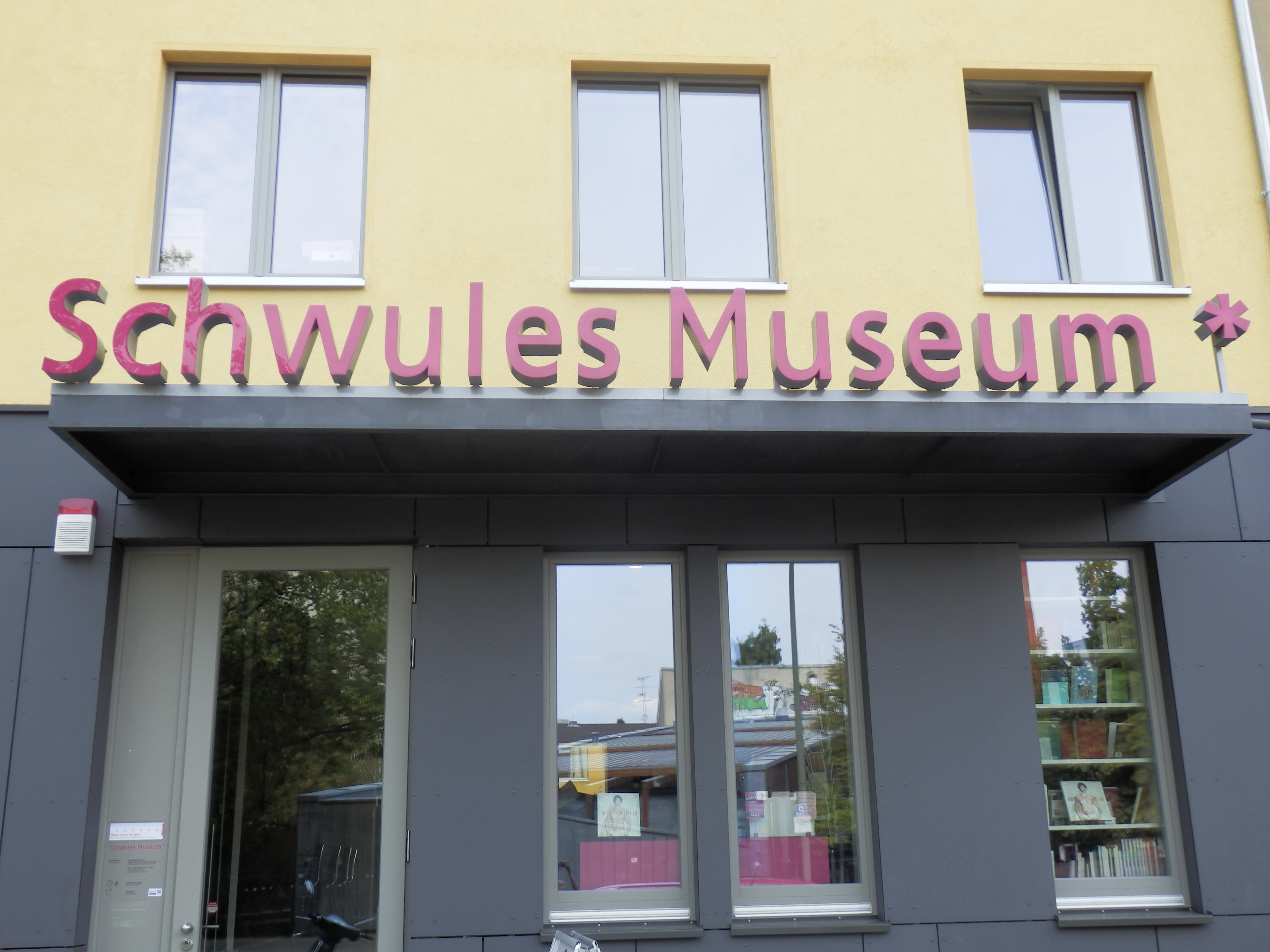
Photo by KimSchneider, CC BY-SA 4.0, via Wikimedia Commons · Report this image
Schwules Museum
A 1985 gay-history museum in a former Tiergarten factory, closing two shows Nov 2.
Published Revised
Reasons to check it out
- Founded 1985 as the first museum in the world dedicated to gay history, after a 1984 exhibition at Berlin's Märkisches Museum proved the archive material existed and had nowhere to live
- Moved 2013 from Mehringdamm to a former printing factory at Lützowstraße 73, Tiergarten — 1,600 square meters over three floors, an archive built where machines used to run
- 'Susan Sontag – Seeing and Being Seen' and 'Cruising the Countryside – Rural Queer Lives' both close 2 November 2026 — see them before the building resets its floor plan
- The basement holds roughly 50,000 objects and periodicals dating to 1896 — the collection outweighs any single show currently on the walls
A building tells you what it was built to do before anyone hangs anything on the walls. Lützowstraße 73 was a printing factory — the kind of structure engineered around machines, not people, wide floor plates and load-bearing columns spaced for presses rather than sightlines. Schwules Museum moved in during 2013, took the shell, and converted it into 1,600 square meters of exhibition space, library, and archive across three levels without pretending the industrial bones weren't there. The ground floor holds four galleries and a café; the upper floor is a reference library and research area; the basement is where the actual weight of the institution sits — an archive of roughly 50,000 objects and periodicals running back to 1896. Most museums are designed as museums from the ground up. This one is a factory that got repurposed to hold memory instead of print runs, and the repurposing is visible if you know what you're looking at.
Why this museum exists at all
The founding logic is unusually traceable. In 1984, the Märkisches Museum staged "Eldorado — Homosexual Women and Men in Berlin 1850–1950," and the show proved something practical: there was enough material, enough documented history, to justify a permanent institution rather than a one-off exhibition. A "Society of Friends of a Gay Museum in Berlin" formed off the back of it, and Schwules Museum opened in 1985 as, by its own and Wikipedia's account, the first museum in the world dedicated to gay history. It got its first public funding from the Berlin Senate only in December 2009 — a 24-year gap between opening and formal state backing that says something about how long institutional recognition trails institutional existence. The collecting mandate has widened since, deliberately, past a male-homosexual-history default toward lesbian and transgender history as well.
What's actually on the walls through November
Two shows currently running both close on the same day: 2 November 2026. "Susan Sontag – Seeing and Being Seen," a comprehensive exhibition on the critic and thinker originally staged at the Bundeskunsthalle Bonn and expanded here with material on her relationship to Berlin, curated by Kristina Jaspers, who researched Sontag's estate at UCLA directly. And "Cruising the Countryside – Rural Queer Lives," curated by Collin Klugbauer — a research-heavy show built from queer printed matter, paraphernalia, and archival material documenting queer life outside the cities, a corrective to the assumption that queer German history is a Berlin-only story. Per Berlin Art Link's review, it leans on documentary film and ephemera rather than spectacle, which fits the museum's whole register: build the case with primary material, let the walls carry it. A third show, "Better Happy Than Normal! Queer Experiences in Christian Fundamentalist Contexts," closes the same November day. The shared end date isn't a coincidence worth reading into — it's a programming cycle — but it does mean the current floor plan has an expiration, and whatever replaces it in November is a different building to visit, functionally, even though the walls stay put.
The infrastructure argument
Berlin's queer landmarks tend to get covered as nightlife — a club, a door policy, a dancefloor. Schwules Museum is the daytime counterpart to that story: an institution built specifically to hold the paper trail nightlife doesn't keep. The same city that's home to SO36, the Kreuzberg punk venue that's also spent 28 years hosting a queer Turkish-Arabic night, needed somewhere to archive the ephemera those decades generate — flyers, periodicals, photographs — before it disappears the way club nights and their posters usually do. A museum and a nightclub aren't in competition for the same visit; they're two different structures doing two different jobs for the same history, one built to hold a party and the other built to hold what's left of it forty years later.
Sources: Schwules Museum — official site, exhibitions listing, berlin.de tickets — 'Susan Sontag – Seeing and Being Seen', berlin.de tickets — 'Cruising the Countryside', Berlin Art Link — review, 'Cruising the Countryside' group show, Wikipedia — Schwules Museum, Wikimedia Commons — File:Schwules Museum* Berlin.JPG