
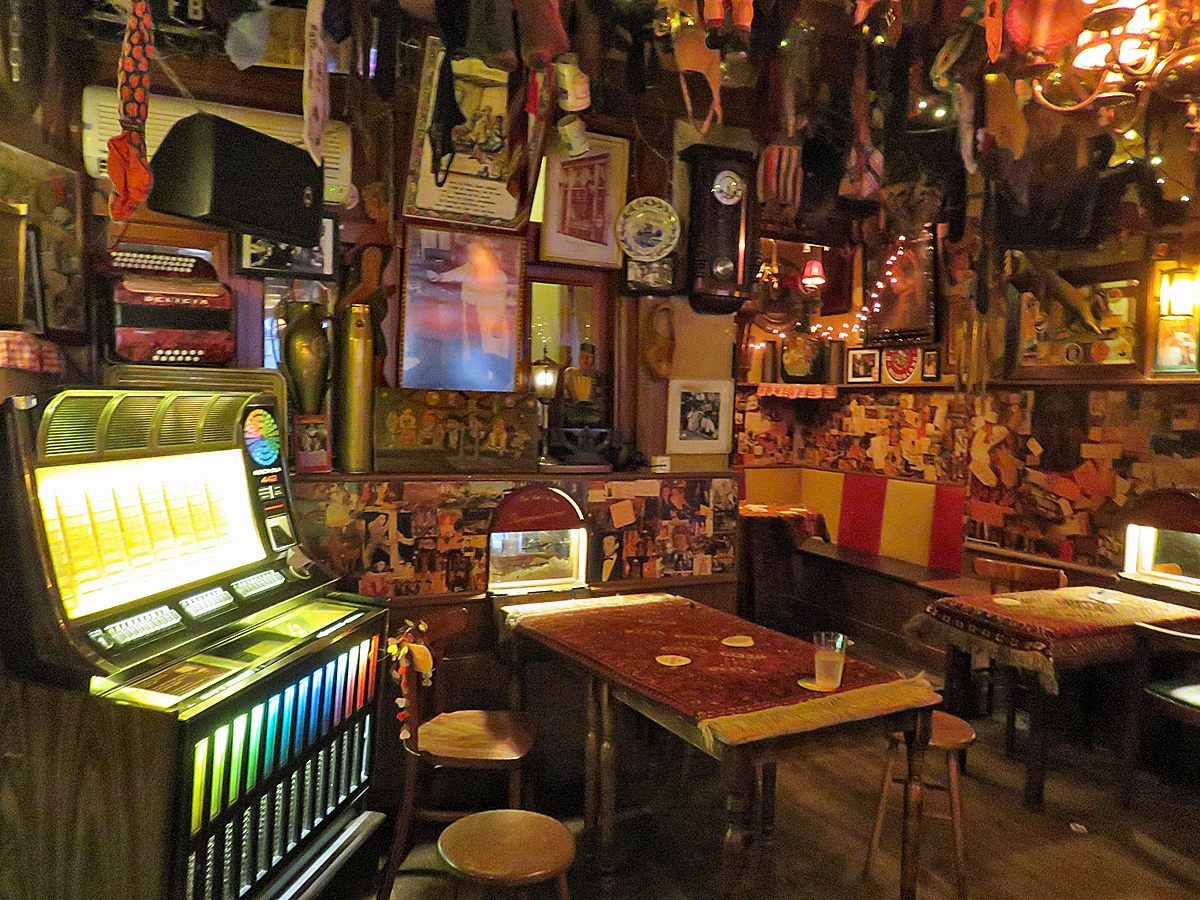
Paul2, CC BY-SA 4.0, via Wikimedia Commons · Report this image
Café 't Mandje
Amsterdam's oldest surviving gay bar, run by the same family since 1927.
Published Revised
Reasons to check it out
- Opened 1927 on Zeedijk 63 by Bet van Beeren, 25, who named it after the basket her mother carried her lunch in
- Bet cut the ties off male visitors and hung them from the ceiling — some are still there
- Closed 1982 after Bet's death and the Zeedijk's drug years; reopened 2008 by her own great-niece, Diana van Laar
- A full-scale replica of the café stands in the Amsterdam Museum
I look for the layer under a room — the version of the place that was here before the version you're standing in. At 't Mandje, on the Zeedijk, you don't have to dig for it. It's nailed to the ceiling.
Bet van Beeren was 25 when she took over the café at Zeedijk 63 from her uncle, in 1927. She came from the Jordaan, and she named the place 't Mandje — "the little basket" — because her mother walked over every day with her lunch in one. That's the whole origin story, and it's the kind I trust: small, domestic, unglamorous, and completely verifiable. No myth-making required.
The ties on the ceiling
What Bet built in that café over the following decades is the part that matters. She decorated the brown café with photographs, trinkets, postcards, newspaper clippings — and with neckties. Her habit, well documented and not exaggerated for effect, was to walk up to a male visitor and cut his tie off with scissors, then hang it from the ceiling. Some of those ties are still up there. That is not a bar with a "quirky theme." That is eight decades of a single woman's running joke, preserved as physical evidence, in the same room it happened in.
The Zeedijk in that era was a port street — sailors, prostitutes, pimps, dockworkers — and 't Mandje became something rarer than a "gay bar" in the modern sense: a genuinely tolerant meeting point where gay men and lesbian women could sit alongside that whole cast without being the exception in the room. Bet herself became known as the uncrowned queen of the Zeedijk, and she was, by all accounts, a committed monarchist — the walls carried photos of her with the Dutch Royal House alongside everything else.
There was, technically, a kissing ban inside — even Bet reportedly thought that particular house rule went too far. But once a year, on Queen's Day, the café threw its Orange balls, and for one night gay and lesbian couples danced together openly on the floor. In a city and a century where that was not a small thing to do in public, a single annual night of visibility inside a working-class brown café is exactly the kind of fact that doesn't need embellishing. It just needs to be said plainly.
The gap, and who closed it
Bet van Beeren died in 1967. Her youngest sister, Greet, took the café over and ran it for fifteen years — a direct continuation, not a reinvention. But by 1982 the drug problems that had taken hold of the Zeedijk made running the place untenable, and Greet closed it. For twenty-six years, 't Mandje sat shut. That gap is the part most write-ups skip past to get to the reopening, but a bar closed for twenty-six years is functionally a different kind of fact than a bar that's merely "old" — it's a building that held its breath.
Here's the detail I actually built this piece around: when 't Mandje reopened on 29 April 2008, it wasn't a stranger with a nostalgia budget buying the name and gutting the interior. Greet van Beeren, then 84, sold the café in 2007 to Diana van Laar — her niece, and Bet's great-niece. The family that started the ceremony in 1927 is the family that restarted it. That's not revival; it's continuation with a pause in the middle. The original interior and furnishings are still in place, which means the café now functions as something close to a living museum of its own history — a claim the city itself backs up, since a full-scale replica of the café exists as a permanent showpiece inside the Amsterdam Museum. The original photographs and documents are archived properly too, split between the Amsterdam City Archives and IHLIA, the Dutch LGBTQ+ archive — the kind of institutional attention a "quirky old bar" doesn't usually get. A foundation, Stichting 't Mandje 1927, now oversees the venue's preservation and cultural programming, which tells you the family itself understands what they're sitting on.
Before you go
't Mandje is open Tuesday through Thursday, 4pm to 1am; Friday and Saturday, 3pm to 3am; Sunday, 3pm to 1am; closed Mondays. It's a small, working brown café on Zeedijk, at the edge of the Red Light District — go for a beer, look up at the ceiling, and remember that every tie up there is a joke Bet van Beeren told with scissors, ninety-some years ago, in the same room you're standing in.
't Mandje is one of the stops in Near's first Ladies&Gentlethem roundup, the monthly queer-nightlife column — worth a look for four other rooms in the same spirit, from London to São Paulo.
Sources: Café 't Mandje — official site, history page, Wikipedia — Café 't Mandje, Wikipedia — Bet van Beeren, Amsterdam Museum — Café 't Mandje showpiece


